Monday, December 16, 2013
Christmas Poems
When I was in college, my folks gave me a collection of Christmas poems by the cowboy poet, Waddie Mitchell. I loved them - and they inspired me to try my hand at cowboy poetry. While my work is not in the same league as Waddie's (as you'll find out in the coming days), I have had lots of fun with it. During the days leading up to Christmas this year, I'll share a few of my favorites. Merry Christmas!


Thursday, December 12, 2013
A Few of our Favorite Winter Recipes
With the winter solstice just around the corner, my culinary thoughts have turned to soups and stews! We've made most of these recipes in both a counter-top slow cooker and in a cast iron Dutch oven - can't go wrong either way! I love coming home to a fire in the wood stove and the aroma of dinner cooking slowly in the kitchen.
Remove most of the fat from the meat. Put it in a pot with the cold water. Bring to a boil and stir in the barley. Simmer, partially covered, for 1-1/2 hours, or until the meat and barley are tender, adding more water if any evaporates. Remove the meat from the bones. Cool the soup and skim off the fat. Melt the butter in a skillet and add the carrots, celery (or fennel), turnip (or rutabaga), and onion. Cook over low heat, stirring often, for 10 minutes. Add to the soup. Season with salt and pepper to taste, and cook for another 10 minutes or until the vegetables are tender. Serve piping hot.
Instructions
Cube the mutton shoulder and brown in olive oil. After browning the meat, saute the onions until slightly browned. Add all ingredients EXCEPT persimmons to slow cooker. Cook on low all day if possible. An hour before serving, dice the persimmons with the skins left on and add to the curry. (we used chocolate fuyus, but any fuyu persimmon will work). If you're using winter squash, add earlier in the process. Serve over rice.
I like to make this recipe in a cast iron dutch oven over a camp fire, but it can be made indoors as well! A crock pot works great!
Prepare meat and brown in the dutch oven. Remove from pot. Add olive oil and saute onion and garlic. Add sausage, beans, wine, water and chilies. Season to taste. Cook low and slow for several hours (or all day, if possible). Have a taste of the red wine. Cook a bit longer. Serve with good bread!
Sheepherder Stew
Ingredients
Brown meat in olive oil. Combine all ingredients in crock pot or dutch oven and cook until vegetables and meat are tender. Serves 4 (with leftovers)
Beer Braised Mutton Rib or Loin Chops
Ingredients
- 4 mutton rib or loin chops
- 1 dark beer
- 1 medium yellow onion, diced
- 3 cloves garlic, diced
- salt, pepper and paprika, and Italian herbs to taste
Instructions
Trim the fat from the chops. Sprinkle with salt and pepper and lightly brown in olive oil. Remove from pan, retaining liquid and oil. Add diced onion and saute' until nearly translucent, then add garlic and saute' for about 2 minutes more. Place chops in slow cooker or Dutch oven. Put onion and garlic mixture on top of chops. Pour beer over the top and add other seasonings. Cook in oven at 300F for 2-3 hours (until meat is tender). Remove meat from pot, skim fat from cooking liquid and make a creamy gravy or reduction sauce. Serve with rice or mashed potatoes. Serves 4.
Scotch Broth
Ingredients
- 3 lbs lamb or mutton neck slices (or shoulder chops)
- 8 cups cold water
- 1/2 cup barley
- 3 TBS butter
- 2 carrots, diced fine
- 2 stalks celery or fennel, diced fine
- 2 small white turnips or rutabagas, peeled and diced
- 1 medium onion, diced fine
- Salt
- Freshly ground pepper
Remove most of the fat from the meat. Put it in a pot with the cold water. Bring to a boil and stir in the barley. Simmer, partially covered, for 1-1/2 hours, or until the meat and barley are tender, adding more water if any evaporates. Remove the meat from the bones. Cool the soup and skim off the fat. Melt the butter in a skillet and add the carrots, celery (or fennel), turnip (or rutabaga), and onion. Cook over low heat, stirring often, for 10 minutes. Add to the soup. Season with salt and pepper to taste, and cook for another 10 minutes or until the vegetables are tender. Serve piping hot.
Mutton Curry
Ingredients
Ingredients
- 2 lbs boneless mutton shoulder - trimmed and cut into 1" cubes
- 4 cups lamb or chicken broth
- 1/2 onion - chopped
- 3 large cloves garlic - chopped
- 1/4 cup coconut milk
- 2 large potatoes - peeled and diced
- 1 large carrot - diced
- 1 can stewed tomatoes
- 1 can garbanzo beans
- 1 can tomato paste
- 3 fuyu persimmons or medium butternut squash, peeled and diced
- 2 tsp meat curry seasoning (available from Spice Grills at the Auburn Farmers' Market)
- Salt to taste
Instructions
Cube the mutton shoulder and brown in olive oil. After browning the meat, saute the onions until slightly browned. Add all ingredients EXCEPT persimmons to slow cooker. Cook on low all day if possible. An hour before serving, dice the persimmons with the skins left on and add to the curry. (we used chocolate fuyus, but any fuyu persimmon will work). If you're using winter squash, add earlier in the process. Serve over rice.
Sheep Camp Beans
Note: this recipe changes every time I make it - depending on what ingredients I have on hand!
Ingredients
Note: this recipe changes every time I make it - depending on what ingredients I have on hand!
Ingredients
- 2 lbs lamb or mutton shoulder - trimmed and cut into 3/4" cubes
- 1 TBS olive oil
- About a half cup of onion
- 5 cloves garlic
- Some red wine (not sure how much - pour till it looks good!)
- Some water (same deal as above)
- 1 can pinto beans (drained)
- 1 can kidney beans (drained)
- 1 can stewed tomatoes (I like the Italian seasoned variety)
- 1 can diced green chilies
- Dash of cinnamon
- Salt and pepper to taste
I like to make this recipe in a cast iron dutch oven over a camp fire, but it can be made indoors as well! A crock pot works great!
Prepare meat and brown in the dutch oven. Remove from pot. Add olive oil and saute onion and garlic. Add sausage, beans, wine, water and chilies. Season to taste. Cook low and slow for several hours (or all day, if possible). Have a taste of the red wine. Cook a bit longer. Serve with good bread!
Sheepherder Stew
Ingredients
- 2 pounds lamb kabobs or stew meat (or mutton)
- 1 large onion – chopped
- 3 cloves garlic - chopped
- 1 medium winter squash (butternut or acorn) – peeled and cut into 1” cubes
- 1 can stewed tomatoes
- 2 cans beans (pinto, black and/or kidney)
- 1 can diced Ortega chilies
- 1 cup red wine
- 2 cups chicken broth
- Season to taste (we use salt, pepper, a pinch of cumin, bay leaves, paprika and basil)
Brown meat in olive oil. Combine all ingredients in crock pot or dutch oven and cook until vegetables and meat are tender. Serves 4 (with leftovers)
The Ethics of Working Stock Dogs

These rules aren't written for a reason, obviously. But sometimes unwritten rules need to be put on paper (or maybe into a blog!) - and that's what I want to attempt here. I hope other stockmen (and women) will weigh in with their perspectives!
As with anything, there is a spectrum of skill levels among dog handlers. I would not count myself as an expert, nor would I presume to be good enough at this stage to train a dog to a competitive level. I do, however, rely on my dogs to accomplish the daily tasks associated with being a shepherd. The simple fact that I need to work with a dog (or two) nearly every day has exposed me to a variety of situations and experiences. I guess this is a long-winded way of saying that I have at least a working knowledge of what a dog can do, and what a dog should do, in a wide variety of situations and conditions.
So here are the rules, at least as far as I can see them:
- If I'm working with another shepherd who is obviously my superior in terms of understanding and working stock dogs, I'm perfectly fine if that person gives my dog a command while we're working. During the work (or more likely, when the task is completed), I'll ask the other person about what they were seeing and what my dog was doing wrong. I find this very helpful! I also find that I don't give their dogs commands under any circumstances.
- If I'm working with someone who is approximately equal with me in ability, I expect that they will not give my dog a command unless the dog is endangering the sheep or the other dog(s). Likewise, I will not give commands to their dog unless I'm worried about the dog being unnecessarily rough with the sheep.
- If I'm working with a person who has less dog and sheep experience than me, I expect that they will not give my dog any commands, period. An inexperienced handler (and I was one once!), at least in my opinion, lacks the contextual knowledge to know if a dog is handling a situation correctly. For example, if a ewe turns on my dog and tries to head-butt and trample him, I want my dog to defend himself. A quick nip on the nose of a charging takes a great deal of courage for a dog - courage that I need in certain situations. If I scold or correct a dog at that point (which I've done as a new handler), I might teach him that he's not to defend himself. By the same token, I will correct a dog that unfairly bites a ewe in the flank after she's given up the fight and turned tail - that's unfair to the ewe, and represents a lack of courage on the dog's part. In real life, these two actions are often only a split second apart - and it's taken me years to learn to recognize and respond with the correct timing. An inexperienced handler can confuse the dog and make the situation worse - especially when he/she is attempting to correct somebody else's dog.
- When working with less experienced handler, I generally won't give his/her dog any commands or corrections if we're working in a training situation. On the other hand, if we're in the midst of a job and the other person's dog is not working right (which puts more stress on the sheep and on my dog), I will step in and offer a correction if it's necessary.
This brings me to the difference between sheep dog trial dogs and ranch dogs. I've heard many ranchers say, "I wouldn't want one of those trial dogs - they don't know what real work is." I've heard trial people who don't rely on their dogs professionally say, "that's just a ranch dog - he'd never make it competitively." From my perspective, the best dogs in either situation are dogs that are trained to a trial standard and that have to work large numbers of sheep everyday. In other words, as a "professional" shepherd, I want a professional dog. While I've never entered a sheep dog trial, I aspire to use dogs to their greatest potential. Much like the buckaroo who won't do any job that can't be done from a horse, a shepherd won't do any job that can't be accomplished in partnership with his/her dogs.
I hope my shepherding and dog trialing friends will add their perspectives - I would expect many different viewpoints! Please leave your comments below!
Thursday, December 5, 2013
December 4, 2013 - A Shepherd's Day in Photographs
I thought it would be fun (at least for me and for my family) to document my day with photographs. Today, I set the alarm on my phone to go off on the hour, with the idea that I'd take a photo that would be indicative of what I was doing at that point in time. I added a few additional photos - there are always interesting things going on where sheep are involved. I'm under no illusions that anyone else will find these photos fun or thought-provoking, but they will serve as a way for me to share my day with my wife and daughters.
The first week of December is typically one of the coldest times of the year in Northern California, and 2013 is no exception. At 4:30 this morning, the cold air coming from the furnace in my trailer awakened me. When it was light, I discovered that I was out of propane.
My work day started with a check of the ewes that were due to have single lambs. I walked through the entire bunch, looking for birthing problems and cold lambs. I did find a ewe who had given birth to a dead lamb. Everybody else looked great!
Then I moved on to the twin-lambing bunch. We've made it through the wave of intensive lambing - only one new set of twins overnight. The ewe was a great mother, and I quickly tagged her lambs and gave them tetanus antitoxin and selenium injections.
Our next task was to finish tagging the rest of the new lambs in this bunch. After sorting out which lambs went with which ewes, we moved the rest of the still-pregnant ewes to another field to finish lambing - consolidating the "drop" bunches will cut down on labor in the coming weeks.
Taking a late lunch, I drove into Rio Vista to pick up propane and pipe insulation, grabbing lunch at Lira's Super Market while I was in town.
After lunch, I built fence, moved the pairs we had tagged that morning, and tagged the 4 new sets of lambs born during the day.
As the sun set, I finished winterizing the water system for my trailer, and drove to Al and Jeannie's home for a quick meeting. I came back to my trailer for dinner and fell asleep watching a movie! Just a typical day for this shepherd!
 |
| When the cold wakes me up, I turn to coffee! |
The first week of December is typically one of the coldest times of the year in Northern California, and 2013 is no exception. At 4:30 this morning, the cold air coming from the furnace in my trailer awakened me. When it was light, I discovered that I was out of propane.
My work day started with a check of the ewes that were due to have single lambs. I walked through the entire bunch, looking for birthing problems and cold lambs. I did find a ewe who had given birth to a dead lamb. Everybody else looked great!
 |
| Bundled up for breakfast! |
 |
| Headed out to work, just as the sun came up. |
 |
| Getting ready to leave the office. |
 |
| If these lambs had cameras, they'd have photographed me! |
Then I moved on to the twin-lambing bunch. We've made it through the wave of intensive lambing - only one new set of twins overnight. The ewe was a great mother, and I quickly tagged her lambs and gave them tetanus antitoxin and selenium injections.
Our next task was to finish tagging the rest of the new lambs in this bunch. After sorting out which lambs went with which ewes, we moved the rest of the still-pregnant ewes to another field to finish lambing - consolidating the "drop" bunches will cut down on labor in the coming weeks.
Taking a late lunch, I drove into Rio Vista to pick up propane and pipe insulation, grabbing lunch at Lira's Super Market while I was in town.
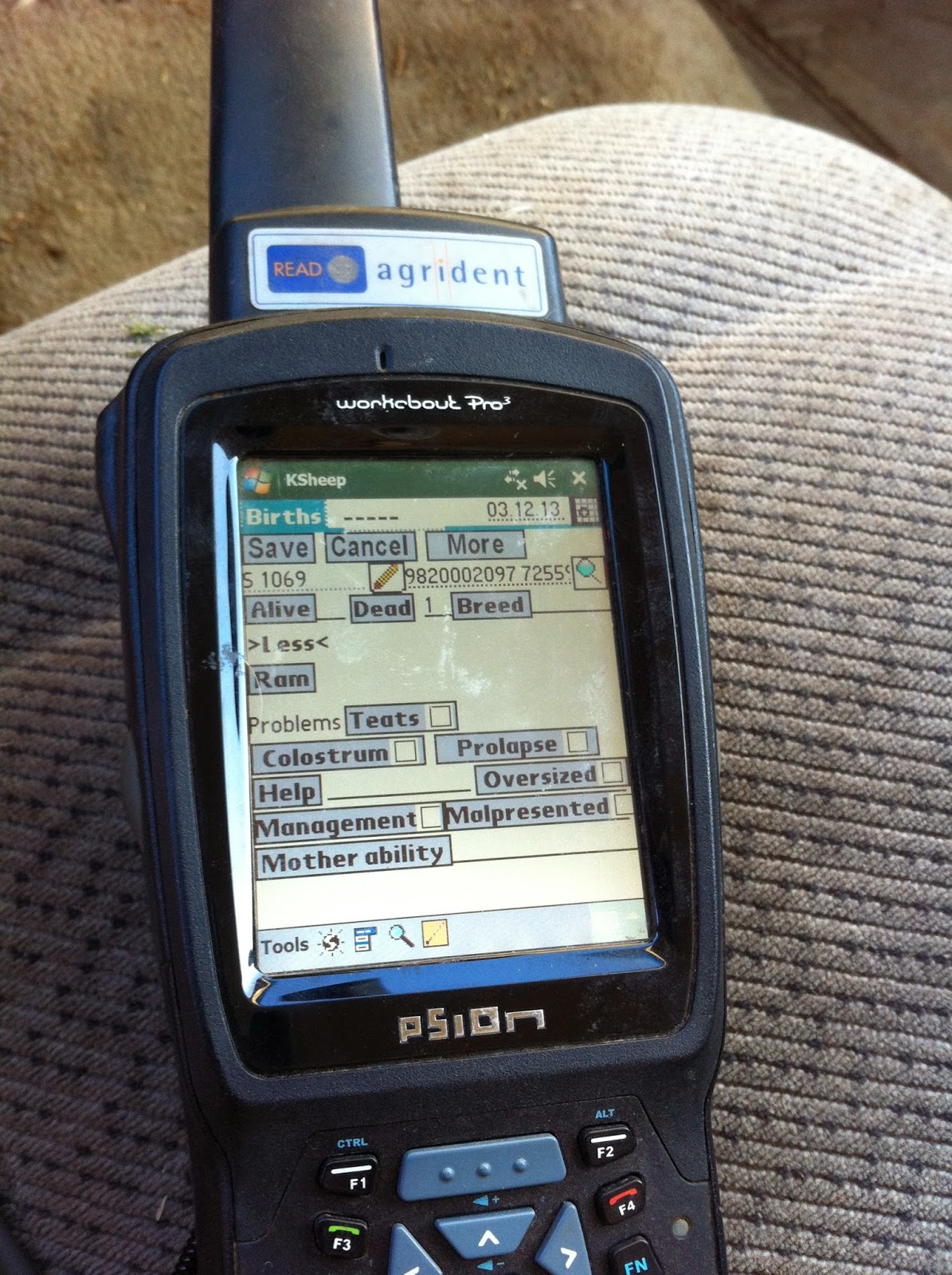 |
| The modern shepherd's notebook - just like UPS! |
 |
| Selfie - with sheep. |
 |
| Moving the last of the drop bunch - with Mo. |
 |
| Catch-pen - tagging lambs. |
 |
| Holding our sheep with Mo - waiting for another group to pass by. |
 |
| Rosie is on the job! |
 |
| Walking the drop bunch past our ewes. |
 |
| Fresh feed! |
After lunch, I built fence, moved the pairs we had tagged that morning, and tagged the 4 new sets of lambs born during the day.
As the sun set, I finished winterizing the water system for my trailer, and drove to Al and Jeannie's home for a quick meeting. I came back to my trailer for dinner and fell asleep watching a movie! Just a typical day for this shepherd!
 |
| Ace Hardware in Rio Vista - picking up propane and pipe insulation! |
 |
| My view at 3 p.m. |
 |
| The water truck, the ewes and lambs, and a very large ship in the background. |
 |
| Sunset on sheep. |
 |
| Sunset on Mt. Diablo. |
 |
| My home away from home. |
Thursday, November 28, 2013
Gratitude
I think that Thanksgiving is my favorite holiday. Not only does it mark the beginning of my favorite season - for me, it's a day to consciously reflect on all the things (big and small) that I'm grateful for. The food isn't too bad, either!
This year, I want to do a simple list of all that I'm thankful for. It's not an all-inclusive list, but here it is:
I'm thankful for my family - immediate and extended.
I'm grateful that I get to do the work of farming with my girls and my wife.
I'm thankful for the community of farmers that I've had the privilege of joining.
I'm thankful for the older generation of farmers who have shared their wisdom, experience and humor with me.
I'm grateful that I get to work outside nearly every day.
I'm thankful for the sights, sounds, smells and experiences that come with working outside.
I"m grateful for the food that will be on our table tonight - and for the food that graces our table everyday. I'm especially grateful to the people who do the work of growing our food.
I'm thankful for my dogs. Somebody told me that there are no great shepherds without great dogs. I aspire to be the great shepherd my dogs deserve!
I'm thankful for my sheep. They are the reason I get to work outdoors everyday!
As the weather grows colder, I'm thankful for wool! I'm thankful for all of the people between the shearer and the seamstress that make wool clothing possible!
I'm thankful that I live in a time and place where my freedom to express myself, to worship (or not) in the place and way of my choosing, and to elect my representatives are protected. I often take these freedoms for granted.
I'm thankful for the men and women through history who have fought and died for these freedoms.
I'm thankful to be sitting in front of a computer with a roof over my head and a fire in the woodstove this morning!
I'm grateful for my new job as a shepherd at McCormack Ranch. I'm grateful to be making a pastoral living.
I'm thankful....
This year, I want to do a simple list of all that I'm thankful for. It's not an all-inclusive list, but here it is:
I'm thankful for my family - immediate and extended.
I'm grateful that I get to do the work of farming with my girls and my wife.
I'm thankful for the community of farmers that I've had the privilege of joining.
I'm thankful for the older generation of farmers who have shared their wisdom, experience and humor with me.
I'm grateful that I get to work outside nearly every day.
I'm thankful for the sights, sounds, smells and experiences that come with working outside.
I"m grateful for the food that will be on our table tonight - and for the food that graces our table everyday. I'm especially grateful to the people who do the work of growing our food.
I'm thankful for my dogs. Somebody told me that there are no great shepherds without great dogs. I aspire to be the great shepherd my dogs deserve!
I'm thankful for my sheep. They are the reason I get to work outdoors everyday!
As the weather grows colder, I'm thankful for wool! I'm thankful for all of the people between the shearer and the seamstress that make wool clothing possible!
I'm thankful that I live in a time and place where my freedom to express myself, to worship (or not) in the place and way of my choosing, and to elect my representatives are protected. I often take these freedoms for granted.
I'm thankful for the men and women through history who have fought and died for these freedoms.
I'm thankful to be sitting in front of a computer with a roof over my head and a fire in the woodstove this morning!
I'm grateful for my new job as a shepherd at McCormack Ranch. I'm grateful to be making a pastoral living.
I'm thankful....
Friday, November 22, 2013
Farmer Amnesia
I have farmed "professionally" since 2002. Eleven years ago this fall, we took our first crop - popcorn, pumpkins and Swiss chard - to the Auburn Farmers Market. That year, and every year since, I've reached a point in the year where I'm absolutely burnt out. Some years, it's been the grind of 70-80 hour work weeks that wears me down. Other years, it's drought or disease problems. When I reach this point, a customer's innocuous comment about high prices at the farmers market, or an unexpected expense, is enough to make me REALLY grumpy - and I wonder if it's worth continuing to farm. Thankfully, each autumn I suffer an extreme case of farmer amnesia - the anticipation of the coming year makes me forget the struggles of the 12 months I've just lived through!
When I grew vegetables, the onset of farmer amnesia usually coincided with the arrival of the Johnny's Seeds Commercial Growers Catalog in my mailbox. My friend and fellow farmer, Jim Muck of Jim's Produce in Wheatland, calls this "farmer porn!" Invariably, I'd find a new variety or a new tool (or both!) that I was anxious to try next year. Despite my best attempts to remain realistic, I'd experience a growing sense of excitement for the coming growing season and a deep desire to get my hands in the soil again.
As our farm transitioned away for crop production and became focused on sheep, the onset of farmer amnesia occurred when we took the rams away from the ewes and settled in for that restful period between breeding and lambing. As the nights grew longer, I found that I no longer needed to work 12-14 hours each day. I started looking forward to lambing (which I like to think of as six weeks of Christmas in February and March). I forgot about the six months of moving irrigation pipe, building fence and hauling sheep!
This phenomenon must be related to the cycles of the year. In the summer months, I find myself working sun-up to sun-down. In the winter, I still work sun-up to sun-down, but the time between these two events is much shorter at our latitude. Dina Moore, a friend who ranches in Humboldt County, says that winter's shorter days force us to rest. As the days grow longer after the Winter Solstice, I find my optimism and enthusiasm about farming returning. Thank goodness for farmer amnesia!
When I grew vegetables, the onset of farmer amnesia usually coincided with the arrival of the Johnny's Seeds Commercial Growers Catalog in my mailbox. My friend and fellow farmer, Jim Muck of Jim's Produce in Wheatland, calls this "farmer porn!" Invariably, I'd find a new variety or a new tool (or both!) that I was anxious to try next year. Despite my best attempts to remain realistic, I'd experience a growing sense of excitement for the coming growing season and a deep desire to get my hands in the soil again.
As our farm transitioned away for crop production and became focused on sheep, the onset of farmer amnesia occurred when we took the rams away from the ewes and settled in for that restful period between breeding and lambing. As the nights grew longer, I found that I no longer needed to work 12-14 hours each day. I started looking forward to lambing (which I like to think of as six weeks of Christmas in February and March). I forgot about the six months of moving irrigation pipe, building fence and hauling sheep!
This phenomenon must be related to the cycles of the year. In the summer months, I find myself working sun-up to sun-down. In the winter, I still work sun-up to sun-down, but the time between these two events is much shorter at our latitude. Dina Moore, a friend who ranches in Humboldt County, says that winter's shorter days force us to rest. As the days grow longer after the Winter Solstice, I find my optimism and enthusiasm about farming returning. Thank goodness for farmer amnesia!
Thursday, November 14, 2013
Pasture Lambing on a Larger Scale
 |
| One of the first sets of twins born on pasture this year. |
Managing my own sheep, I've always lambed on pasture rather than in a barn (for a full description of the system we've used, see Lambing on Pasture). As I wrote last February, pasture lambing has several advantages (at least in our system):
- Lower (or no) capital costs for barns and other structures.
- Healthier lambs and ewes - very few of the respiratory problems that often come with lambing in an enclosed area.
- The development of a ewe flock with tremendous mothering abilities - ewes that give birth without assistance, develop a mother-lamb bond quickly, and produce plenty of milk.
- Lower feed costs - little or no supplemental feed is required.
In my new job, I'm helping ranch manager Ellen Skillings develop and implement a pasture lambing system on a much larger scale. We'll be lambing out 1700 ewes (including mine) between November 1 and the end of March (the fall lambing ewes will finish up before Christmas - we'll have month-long break before the spring lambing ewes begin). On this operation, the motivations and benefits of pasture lambing (as opposed to barn lambing) are different, as are the techniques. Regardless, I continue to be sold on the system compared to the barn lambing alternative!
Over the last week, I've had several conversations with two of my fellow employees at the ranch regarding this system. Both men are hard workers, and one in particular has had a great deal of experience working with sheep. Walter has never worked in any system BUT barn lambing, and I get the feeling that many of the herders at surrounding ranches share his skepticism about our new approach. Thinking about these conversations has helped me clarify my own preferences for lambing on pasture.
First I should more fully describe our system. Earlier this fall, each potentially bred ewe was ultrasounded to determine how many lambs she was carrying. This process allowed us to sort the open ewes (those that were not bred) from the bred ewes. It also allowed us to further sort those carrying single lambs from those that appeared to have multiple lambs (mostly twins).
Ewes that are carrying and nursing twins need more higher quality forage than those with single lambs. We put the single bunch on dry pasture and started feeding them grass hay and alfalfa. The two twin bunches are grazing on alfalfa. A fourth group, which we call the primalas (because this is their first lambing), is on alfalfa close to the main barn - first-lamb ewes can have more lambing and mothering problems, so we wanted them close to barn in case they needed to come in for assistance.
Under the old system, nearly every ewe came into a barn at lambing. These ewes were put into "jails" - small pens - until they had fully bonded with their lambs. Then they were combined with 3-4 other "pairs" - ewes with lambs - in mixing pens before eventually going back out on pasture. In this system, each jail and mixing pen needed fresh water and hay twice a day. Once a pen was emptied, it needed to be cleaned and re-bedded before the next ewe arrived. The old system required lots of harvested feed (mostly hay) and lots of labor. Furthermore, the old system masked mothering problems. By forcing ewes to bond with their lambs artificially, the old system failed to select for appropriate mothering instinct and ability.
 |
| Drifting the "old" pairs forward to join the "new" pairs. |
 |
| High quality forage is critical to a pasture lambing system - as is controlled grazing. We use electro-nets to manage grazing on alfalfa. |
There are several steps we're taking this year that will make this system work even better in years to come - and several things we'll do differently next year. First, we are recording every ewe's performance in three criteria - lambing ease, mothering ability and lamb vigor. A good pasture-lambing ewe should lamb without assistance, should stay with her lambs at all times (even when we're processing the lambs), and should produce enough milk for her lamb to grow rapidly. By recording performance, we'll be able to cull the ewes that fail in any one of these categories. We'll also be able to make better decisions about which of this year's ewe lambs to keep as replacements. The daughter of a ewe who had problems won't stay in our flock. Secondly, the ranch has initiated an electronic identification system. We use EID ear tags in the ewes and lambs and handheld readers to record birth information. This information is automatically loaded onto our computer system each evening and will give us the ability to quickly evaluate a variety of performance factors in addition to the mothering data described above.
I'm finding that these ewes are not as comfortable with humans around as my ewes (who are used to seeing me everyday). Consequently, we're finding that we can't always get close enough to a new mother to scan her EID ear tag or to read her farm tag. Next year, we'll paint brand each ewe's ID number on her back prior to lambing (I'm actually going to try this with my ewes this spring).
One of the reasons that the staff has had trouble adjusting to this new system, I think, is that a new task seems to take longer than a job that we're used to. It used to take all day to bring sheep in, put older pairs into mixing pairs and then back out on pasture, feed the barn-housed sheep, change bedding, etc. Now it takes all day to move fences and feed sheep in the pastures. Routine is comfortable; change is not - even if change is for the better, I guess. My job, in part, is to help the guys become comfortable in this new system and to understand the bigger picture. To me, the bigger picture is that we'll have more lambs raised by their mothers without much help from us. We'll have healthier lambs and ewes - and ultimately more lambs to sell.
Subscribe to:
Posts (Atom)
-
 Folks who don't raise grass (not that kind of grass!) and harvest it with grazing animals, I suppose, probably think we ranchers are a...
 -
 Mo keeping track of our newest bummer lamb If you raise sheep, at some point, you'll have a lamb whose mother won't - or can...
 -
 Here's the next installment from my Sheep Management Basics talk: Overview – Why Not Lamb in a Barn? Conventional wisdom indicate...